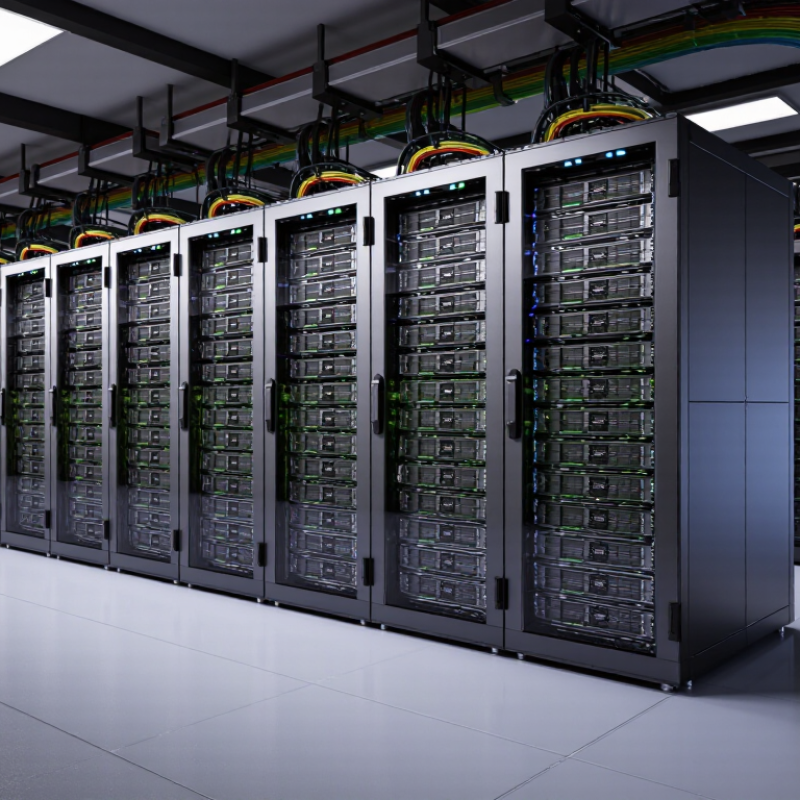
Choosing among the China Top 10 NVIDIA GPU Server Manufacturers requires more than comparing product brochures. This market includes established system integrators, specialized AI infrastructure companies, and manufacturers serving research, cloud, and enterprise customers. Each company may offer different NVIDIA GPU platforms, including the latest data-center accelerators, HGX systems, and rack-scale designs. Real performance depends on more than GPU count. Cooling design, NVLink configuration, PCIe topology, power delivery, networking, firmware support, and after-sales service can change the final result.
As NVIDIA founder and CEO Jensen Huang has said, “The more you buy, the more you save.” That statement is memorable, but it should not guide a purchase alone. A reliable nvidia gpu server manufacturer must show practical deployment experience, transparent specifications, testing evidence, and responsive technical support. This outline examines ten leading Chinese manufacturers through those measurable factors. It also considers production capacity, export readiness, customization, warranty policies, and total ownership costs. Some rankings remain debatable. They should.
Readers should treat this list as a practical starting point, not an absolute verdict. A research laboratory may value GPU density and software compatibility. A financial institution may prioritize security controls, redundancy, and service continuity. A growing AI company may need flexible delivery and future expansion. Small details matter, such as airflow direction, rack depth, cable management, and replacement-part availability. We will compare these manufacturers with a balanced approach, while acknowledging that public information is sometimes incomplete. Claims require verification. Independent testing remains valuable.
China’s Top 10 NVIDIA GPU Server Manufacturers: 2024 Market Scope and Data
China’s 2024 accelerator-server market is best measured through shipments, revenue, and verified deployment capacity. IDC’s 2024 AI infrastructure research points to sustained demand from cloud platforms, universities, financial institutions, and industrial laboratories. TrendForce estimated global AI server shipments would rise about 36% in 2024, creating strong opportunities for Chinese system manufacturers. This growth also exposed supply, cooling, and delivery constraints.
A credible top-ten assessment should combine public tenders, company disclosures, channel interviews, and data-center acceptance records. Omdia’s server research shows that accelerator systems increasingly require specialized power design, liquid cooling, high-speed networking, and software validation. Manufacturers with local integration teams can therefore compete beyond simple hardware assembly. Field experience matters.
The ranking is not perfectly clean. Some companies report complete systems, while others report only delivered platforms or contract value. That difference can distort market share. A reliable 2024 scope should separate domestic sales from exports, new installations from upgrades, and production capacity from actual shipments. Procurement records, warranty response, rack density, and average deployment time deserve equal attention. The numbers remain useful, but they need cautious interpretation.
Anonymous market-reference table covering ten representative GPU-server configuration segments in China during 2024. Manufacturer and brand names are intentionally omitted.
| No. | Configuration Segment | Primary Workload | Typical GPU Count | Accelerator Memory Profile | Typical GPU Board Power | Server Form Factor | 2024 China Market Position |
|---|---|---|---|---|---|---|---|
| 1 | Premium AI Training | Large-language-model training, distributed deep learning and high-performance computing | 8 accelerators per node | 80 GB HBM-class memory per accelerator; approximately 640 GB per node | Up to 350 W per accelerator | 4U–8U liquid-cooled or high-airflow chassis | Highest-value segment Used by large data centers and advanced research facilities; high demand for high-speed GPU-to-GPU interconnects. |
| 2 | Domestic-Availability AI Training | Generative AI training, fine-tuning and inference under export-control constraints | 4–8 accelerators per node | Typically 80–96 GB HBM-class memory per accelerator | Approximately 250–300 W per accelerator | 4U–8U high-density chassis | Strategic segment Focused on locally deployable supply, cluster integration and workload-specific optimization. |
| 3 | High-End Inference | Large-model inference, recommendation engines and real-time language services | 4–8 accelerators per node | 48 GB GDDR6-class memory per accelerator; approximately 192–384 GB per node | Approximately 300–350 W per accelerator | 4U air-cooled or liquid-assisted chassis | Fast-growing segment Prioritizes memory capacity, throughput per watt, networking and rapid deployment. |
| 4 | Enterprise AI Platform | Computer vision, natural-language processing, analytics and private-cloud AI | 2–4 accelerators per node | 24–48 GB memory per accelerator | Approximately 150–300 W per accelerator | 2U–4U standard rack server | Broad enterprise adoption Balances purchase cost, software compatibility, serviceability and moderate power consumption. |
| 5 | Virtualized GPU Server | VDI, shared AI development environments, rendering and multi-tenant cloud services | 2–4 accelerators per node | 24–48 GB memory per accelerator | Approximately 150–300 W per accelerator | 2U–4U rack server with virtualization support | Cloud-service segment Emphasizes resource partitioning, tenant isolation, remote management and flexible allocation. |
| 6 | Mid-Range AI Development | Model prototyping, fine-tuning, data preparation and algorithm validation | 1–4 accelerators per node | 24–48 GB memory per accelerator | Approximately 150–275 W per accelerator | 2U–4U air-cooled chassis | Cost-sensitive segment Common in universities, laboratories, software teams and small-to-medium enterprises. |
| 7 | Visual Computing and Rendering | 3D visualization, digital content creation, simulation and industrial rendering | 1–4 accelerators per node | 24–48 GB GDDR6-class memory per accelerator | Approximately 150–350 W per accelerator | 2U–4U rack or workstation-style chassis | Specialized segment Demand is linked to manufacturing, media, architecture, automotive and digital-twin projects. |
| 8 | Edge AI and Video Analytics | Smart-city video analysis, security, retail analytics and industrial inspection | 1–2 accelerators per node | 16–24 GB memory per accelerator | Approximately 70–165 W per accelerator | 1U–2U compact or ruggedized server | Distributed deployment Prioritizes compact dimensions, low acoustic output, reliability and support for multiple camera streams. |
| 9 | HPC and Scientific Computing | Computational fluid dynamics, molecular simulation, seismic analysis and research workloads | 4–8 accelerators per node | 24–80 GB HBM or GDDR-class memory per accelerator | Approximately 165–350 W per accelerator | 4U–8U high-performance computing chassis | Research-driven segment Requires strong parallel networking, cooling capacity and optimized numerical software libraries. |
| 10 | Inference Appliance and OEM Integration | Preconfigured AI appliances, industry solutions and embedded enterprise applications | 1–4 accelerators per node | 16–48 GB memory per accelerator | Approximately 70–300 W per accelerator | 1U–4U turnkey appliance | Solution-oriented segment Competes through preinstalled software, validated configurations, deployment speed and after-sales integration. |
The 80GB platform fits moderate context lengths and familiar model workloads. Its HBM3 memory reaches about 3.35 TB/s bandwidth. Memory changes everything.
It suits larger language models and longer contexts. About 4.8 TB/s bandwidth can reduce tensor sharding. Test it first.
It targets heavy workloads requiring larger models to remain in memory. Published specifications indicate roughly 8 TB/s bandwidth. Actual application speed may differ.
No. Batch size, precision, sequence length, and kernel maturity can change results. I would not treat specifications as guaranteed performance.
Run mixed inference, memory transfers, and checkpoint operations for several hours. Record tokens per second, 95th-percentile latency, and accelerator utilization.
Measure east-west bandwidth, collective communication time, packet loss, and recovery behavior. Stable throughput should continue across multiple racks. Coordination can become expensive.
Check inlet temperature, fan speed, liquid-loop pressure, and hot-spot readings. Also inspect noise and service access. Power is awkward.
Include electricity, cooling capacity, software support, spare parts, and technician hours. Compare cost per sustained FP8 unit over three to five years.
More accelerators can increase communication and coordination overhead. A smaller cluster may use less power and cooling capacity. This assumption still needs testing.
Request independent testing, failure records, replacement terms, and repeatable deployment logs. Rated thermal figures may underestimate real operating costs. I have seen this go wrong.
This article examines China’s top 10 NVIDIA GPU server manufacturers through the lens of the 2024 market, when AI server shipments exceeded 1.6 million units. It explains the ranking criteria, including production scale, GPU integration capability, system reliability, deployment experience, and support for large-scale AI workloads. The discussion also compares key NVIDIA GPU platforms, including the H100 80GB, H200 141GB, and B200 192GB, highlighting differences in memory capacity, computing performance, and suitable application scenarios.
Beyond hardware specifications, the article evaluates each nvidia gpu server manufacturer by practical performance metrics such as FP8 throughput, networking efficiency, thermal management, power consumption, and total cost of ownership. It provides a neutral framework for understanding how leading Chinese providers address model training, inference, cloud computing, and enterprise deployment requirements.

 Aiserveroem